Complete Beginner's Guide to American Mahjong
Learn the fundamentals of American Mahjong from scratch. This guide covers tiles, setup, basic gameplay, and essential concepts for new players.
Watch & Learn
Prefer video? Learn from expert instructors.
Captions available via YouTube player controls.
Captions available via YouTube player controls.
What is American Mahjong?
American Mahjong is a tile-based game for four players that combines strategy, skill, and a bit of luck. Originating from China, the American version developed its own unique rules in the 1920s and has been standardized by the National Mah Jongg League (NMJL) since 1937.
Unlike Asian variants, American Mahjong uses an annual card that defines the winning hands for that year. This card changes each spring, keeping the game fresh and requiring players to adapt their strategies annually.
The game involves drawing and discarding tiles to form a complete hand matching one of the patterns on the official card. The first player to complete a valid hand calls 'Mahjong!' and wins the round.
Tips
- You'll need the current year's NMJL card to play
- Most games take 15-30 minutes per round
- Four players is standard, but 2-3 player variants exist
The Tiles
For NMJL play, you need 152 tiles: 108 suits, 28 honors, 8 flowers, and 8 jokers. Sets ship with 160-166 tiles total, including extra jokers and blank spares. Understanding the tiles is your first step to mastering the game.
SUITS (108 tiles): There are three suits, each numbered 1-9 with four copies of each tile. Dots (circles) represent coins, Bams (bamboo) represent strings of coins, and Craks (characters) show Chinese numerals with the 'wan' (10,000) symbol.
HONORS (28 tiles): These include Winds (East, South, West, North - 4 each = 16 tiles) and Dragons (Red, Green, White/Soap - 4 each = 12 tiles). Honors can only form sets of three or four identical tiles, never sequences.
FLOWERS (8 tiles): Decorative tiles that appear in many hands on the card. In American Mahjong, Flowers can form pairs and sets, unlike in Asian variants where they're just bonus tiles.
JOKERS (8 tiles): Unique to American Mahjong! Jokers are wild cards that can substitute for any tile in a Pung (3), Kong (4), Quint (5), or Sextet (6). They CANNOT be used in pairs or single tiles.
Tips
- The 1 and 9 of each suit are called 'terminals'
- The White Dragon (Soap) is often shown as a blank tile with a border
- Learn to recognize tiles quickly - it speeds up your game significantly
Setting Up the Game
BUILDING THE WALLS: Place all tiles face-down in the center and shuffle thoroughly. Each player builds a wall against their rack - two tiles high, 19 stacks long (38 tiles total per wall).
CHOOSING EAST: Roll dice or draw tiles to determine who is East (the dealer). East has special significance - they start the game with 14 tiles instead of 13 and take the first discard.
DEALING: Starting from East, players take turns drawing from the wall. Each player draws 4 tiles at a time until everyone has 12, then 1 more tile each for 13 total (East gets 14). The deal moves counter-clockwise.
The Charleston
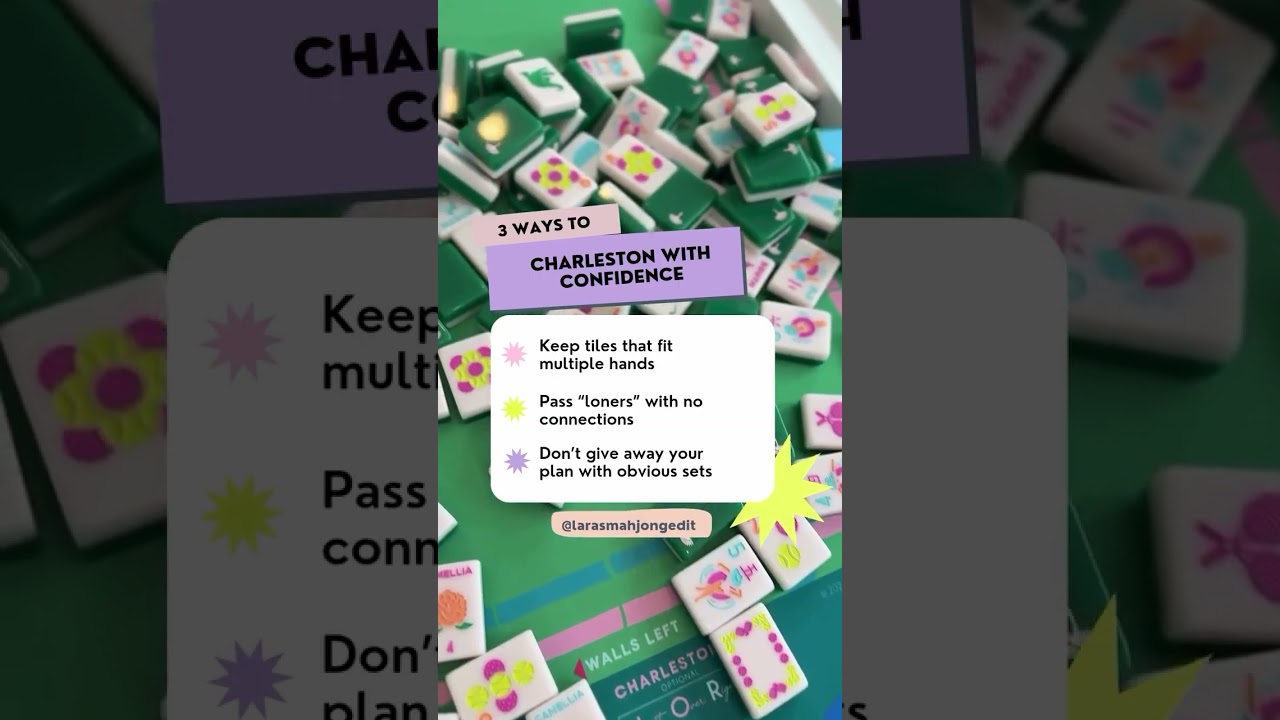
Video by Lara's Mahjong Edit

Video by The Mahjong Line
The Charleston is a unique American Mahjong tradition - a pre-game tile exchange that gives everyone a chance to improve their starting hand. It's named after the dance because tiles move around the table!
FIRST CHARLESTON (Mandatory): Pass 3 tiles to the player on your right, then 3 to the player across, then 3 to the player on your left. On the third pass (left), you may optionally 'blind pass' - passing tiles you just received without looking at them first.
SECOND CHARLESTON (Optional): If all four players agree, repeat the process in reverse - left, across, right. Any player can stop the second Charleston.
COURTESY PASS (Optional): After the Charleston, you may exchange 1-3 tiles with the player across from you, if both agree on the number.
Tips
- Pass tiles that don't fit your developing hand
- Watch what others pass - it gives clues about their hands
- Keep Jokers and Flowers unless you're sure they won't help
Basic Gameplay
DRAW AND DISCARD: On your turn, draw one tile from the wall (or claim a discard). Add it to your hand, then discard one tile face-up in the center, announcing its name clearly.
CALLING TILES: When another player discards a tile you need, you can 'call' it. Say the type of meld (Pung, Kong, etc.) and expose the completed set on your rack. You must expose the meld - no hiding it!
CALLING RULES: You can only call a discard if it completes a meld of 3+ tiles (Pung, Kong, Quint) or completes your Mahjong. You CANNOT call for a pair unless it wins the game.
EXPOSURES: When you call a tile and expose a meld, you're giving information to other players. This is a strategic trade-off - you get the tile you need, but everyone knows part of your hand.
WINNING: When you complete a hand matching the card, call 'Mahjong!' You can win by drawing from the wall (self-pick) or calling someone's discard. Show your hand to verify it matches the card.
Tips
- Always announce discards clearly - 2 Dot, 6 Bam, Red Dragon, etc.
- Keep discards organized so players can see what's been played
- A 'dead' hand is one that cannot possibly win - know when to give up
Understanding the Card
The NMJL card is your roadmap to winning. It lists all valid hands organized into categories like 2468 (even numbers), Like Numbers, Quints, and more.
READING THE CARD: Each hand shows the exact tiles needed. Numbers represent tiles, Dragons are shown as D, Flowers as F. Colors indicate suit relationships — same color means same suit, different colors mean different suits. The point value is shown at the end.
CATEGORIES: Hands are grouped by theme - Consecutive Run, 13579, 2468, Like Numbers, Addition Hands, Quints, etc. Learn to recognize which categories match your starting tiles.
CONCEALED vs EXPOSED: A 'C' after a point value means the hand must be concealed (no called tiles). These are harder but worth more points. Most hands can be played either way.
Tips
- Study the card before playing - familiarity is key
- Highlight or tab hands you like
- Higher point hands are harder to make
Essential Terms
PUNG: Three identical tiles (e.g., three 5 Bams)
KONG: Four identical tiles (e.g., four Red Dragons)
QUINT: Five identical tiles - only possible with Jokers
PAIR: Two identical tiles - Jokers cannot be used
EXPOSURE: Tiles called and shown on your rack
CONCEALED: A hand with no exposures (all self-drawn)
DEAD HAND: A hand that cannot possibly win
WALL GAME: When all tiles are drawn with no winner
Key Takeaways
- American Mahjong requires 152 tiles for play (sets ship with 160-166 including spares)
- Get the current NMJL card - it changes each spring
- The Charleston is mandatory and helps improve your hand
- Jokers are wild but only in sets of 3 or more tiles
- Call tiles to complete melds, but exposures give away information
- Study the card to learn valid winning hands
Put It Into Practice
Reading is a start — playing with the tiles is how it sticks. Try our free practice tools, no sign-up needed.
Frequently Asked Questions
Ready to Start Playing?
Find a teacher near you or connect with local players to get started.