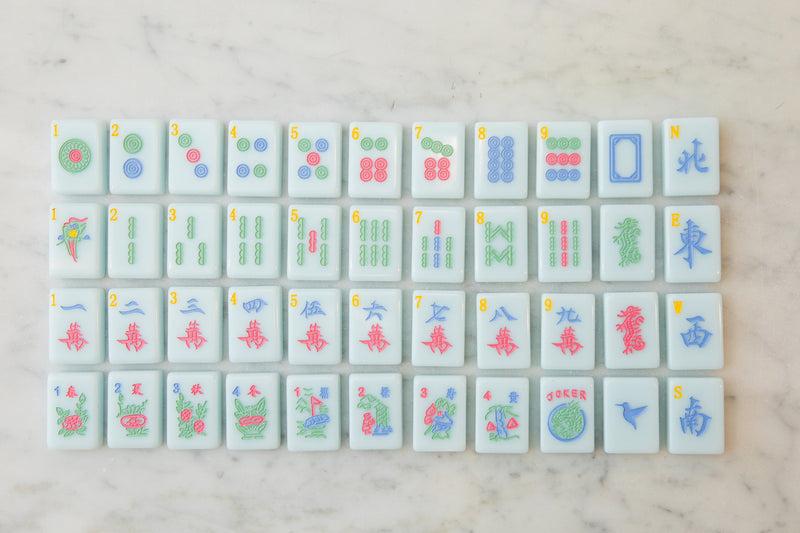
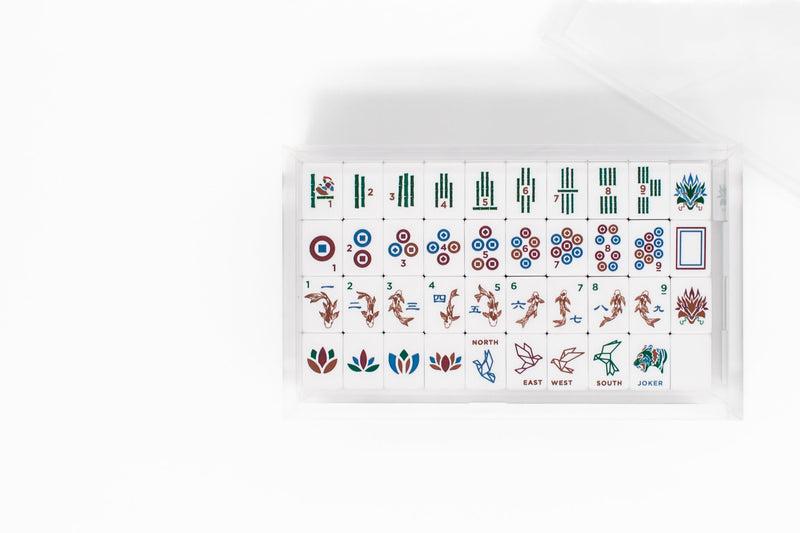
Comparison Guide
American vs Chinese Mahjong
Same family of games, different rules. This guide explains the key differences so you can choose the right style for your group.
Play What Your Group Plays
The style to learn is whichever your local group plays. In the US, American mahjong (NMJL rules) is the most common at clubs, JCCs, and social groups. If you're joining an existing group, learn their style. If starting fresh, American mahjong gives you the most opportunities to find games in the US.
Quick Comparison
| Feature | American (NMJL) | Chinese |
|---|---|---|
| Tile Count | 152 tiles | 144 tiles |
| Jokers | Yes (8 tiles) | No |
| Winning Hands | ~65-75 specific patterns on card | Any valid set combination |
| Rules Change | New card each spring | Fixed (never change) |
| The Charleston | Yes (tile exchange) | No |
| Call Sequences | No (chows not allowed) | Yes |
| Scoring | Point values on card | Complex point system |
| US Popularity | Dominant | Niche |
| International | Rare outside US | Widespread |
Understanding Each Style
American Mahjong (NMJL)
The most popular style in the United States. Uses an annual card from the National Mah Jongg League that defines all valid winning hands. Features jokers and the Charleston tile exchange.
Advantages
- Clear winning hands (on the card)
- Jokers add strategic flexibility
- Charleston creates social interaction
- Consistent rules across US players
- Active community at JCCs, clubs, cruises
- Fresh challenge each year with new card
Drawbacks
- Must buy new card yearly ($14)
- Learning 65-75 hands takes time
- Can't call sequences (chows) from discards
- Less popular outside the US
- Harder to find games internationally
Best for: US players, social groups, those who enjoy structured patterns and annual variety
Chinese Mahjong
The original style from which all variants evolved. Many sub-variants exist (Cantonese, Sichuan, MCR). Rules are fixed and don't change year to year. More popular in Asia and competitive/gambling contexts.
Advantages
- No annual card purchase needed
- Rules never change
- Can call sequences from discards
- More internationally recognized
- Deeper strategic variety
- Gateway to other Asian variants
Drawbacks
- Complex scoring system
- Many regional variations
- Less structured for beginners
- Smaller US community
- Harder to find consistent groups
Best for: Those interested in traditional gameplay, competitive players, international travelers
Key Differences Explained
The NMJL Card
American mahjong's defining feature is the annual card. Published each spring by the National Mah Jongg League, it lists specific hand patterns (typically 65-75 each year) grouped by category (2468, Consecutive Run, Winds-Dragons, etc.). To win, your 14 tiles must exactly match one pattern. This creates consistency across players and a fresh challenge each year.
Jokers
American mahjong includes 8 joker tiles that can substitute for any tile in a pung (three of a kind) or kong (four of a kind). Jokers cannot be used in pairs or in "singles and pairs" hands. This flexibility allows more creative hand-building but also adds strategic complexity.
The Charleston
Unique to American mahjong, the Charleston is a tile-passing ritual before play begins. Players pass 3 tiles right, 3 across, 3 left, with an optional second round. This social element lets players improve their starting hands and is often when players decide which card hand to pursue.
Calling Rules
In Chinese mahjong, you can call "chow" to take a discarded tile to complete a sequence (e.g., 4-5-6). American mahjong doesn't allow this—you can only call discards for pungs (three of a kind), kongs (four of a kind), or to complete your winning hand. This makes American mahjong more defensive.
Which Style Should You Learn?
Choose American Mahjong If...
- • You live in the United States
- • You want to join local clubs or groups
- • You enjoy JCCs, senior centers, or cruise games
- • You like structured patterns to build
- • You want variety with annual card changes
- • Your friends already play NMJL rules
Choose Chinese Mahjong If...
- • You travel internationally often
- • You want fixed rules that never change
- • You prefer not to buy annual cards
- • You're interested in competitive play
- • You want to learn other Asian variants later
- • Your group already plays Chinese rules
Not Sure? Start With What's Available
Check your local community centers, JCCs, and libraries for mahjong groups. Most will play American mahjong in the US. Learning whatever style your local group plays gets you playing faster and gives you people to practice with. You can always learn another variant later—the core skills transfer.
American Mahjong Sets to Consider
Most US readers land on American mahjong. These are current picks across price points, with live pricing and availability from each retailer.
Affiliate Disclosure: We earn a commission if you make a purchase, at no additional cost to you. Learn more